Work out your monthly payment, deposit and total cost for a prefab home in Germany in 3 minutes, check KfW 300 and KfW 297, and see what banks expect from international buyers.

I help international families navigate the path to homeownership in Germany. Many think building a house here is too complicated or too expensive – we prove the opposite. Let's check if you're ready to go!
Four guide figures for a first estimate. The budget planner below works out your own numbers.
As of November 2026. KfW details from KfW 300 and KfW 297/298. KfW leaflets and your financing partner are binding. This is general information, not legal or tax advice.
Should you build or buy a house in Germany? Watch this breakdown of the real costs – and learn how the KfW government loan can make building more affordable than you think.
Adjust the values to your situation and instantly see how your dream home can be financed.
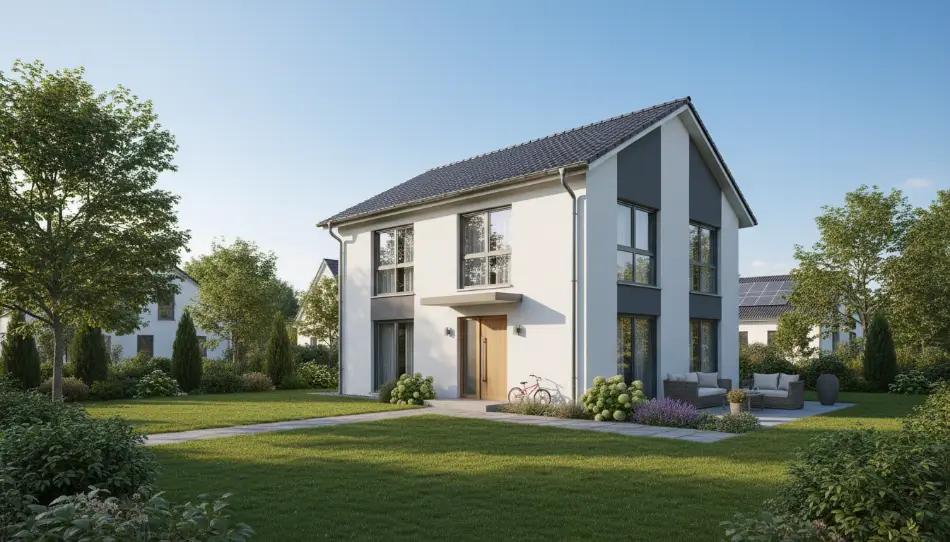 AI-generated
 AI-generated
The questions international buyers ask Google and AI assistants most often, answered briefly and with numbers.
Yes. As a rule, German law does not restrict home ownership by nationality or residence. The real hurdle is financing, because banks look closely at your residence status, your job and your deposit.
Yes, but fewer banks will lend, and many ask for a higher deposit. A permanent residence permit (Niederlassungserlaubnis) or EU citizenship gives you the strongest position. It helps if you have a work permit, have passed your probation period and have steady German income.
Often, yes. A Blue Card shows qualified, well-paid work and can lead to permanent residence after 21 to 33 months. Banks still treat it differently, so compare several lenders or use an independent mortgage broker who works with international clients.
Plan on 20 to 40% as a non-EU buyer, depending on your permit and the bank. Non-residents can be asked for more. On top of that, closing costs usually have to come from your own funds, as banks rarely finance them.
KfW's programme page sets no nationality condition. The home must be in Germany, you must live in it yourself, and for KfW 300 it must be your only residential property in Germany. Foreign tax certificates are accepted with a certified translation. Your bank submits the application, so ask early whether it handles your case. See KfW for details.
No, but the notary appointment for buying land is held in German, and a non-German speaker needs a translator or interpreter there. Grace supports international families in English.
A common rule is to keep your monthly payment within 35 to 40% of net household income. On €5,000 net that means €1,750 to €2,000 a month. At about 4% interest and 1.5% repayment, €1,750 carries a bank loan of roughly €380,000. Your deposit comes on top. KfW loans can stretch this further. Use the budget planner above with your own numbers.
A turnkey prefab home from the floor slab up costs around €2,400 to €3,300 per m² of living space, based on our experience in 2026. Land, floor slab, outdoor areas and garage come on top. See the full free project calculation.
Land transfer tax is 3.5 to 6.5% depending on the federal state. Notary and land registry add about 2%. If an agent is involved, commission comes on top. For the build itself, guides allow 15 to 20% of construction cost for site work, connections and permits.
It depends on your region, land price and funding. New builds avoid hidden renovation costs, have low energy bills and can qualify for KfW new-build loans. The video above compares the real costs.
KfW 300 (“Wohneigentum für Familien”) offers low-interest loans for families and single parents with at least one child under 18. Taxable household income must stay under €90,000 with one child, plus €10,000 per further child. Loans run from €170,000 to €220,000, and with the QNG sustainability seal from €220,000 to €270,000.
KfW 297 has no income limit and does not require children. It offers up to €100,000 per unit, or up to €150,000 with QNG. KfW 300 is for families only, with higher amounts. Both need an Efficiency House 40 and no oil, gas or biomass heating. The Efficiency House 55 option runs only until 31 December 2026 as things stand.
Before you sign building or purchase contracts, unless they include a condition precedent. Work may only start after you apply. Your bank files the application, and you need confirmation from an energy-efficiency expert.
With a prefab home, plan about 7 to 8 months from building permit to move-in. Assembly takes 2 to 3 days. Finding land, planning and the permit come first and vary a lot by municipality.
We work with independent financing advisors who are not tied to any single bank. They compare the best rates on the market and find the ideal financing solution for your project – free of charge and with no obligation.
Your budget planner data will be sent automatically so we can assess your situation right away.
We use cookies and similar technologies to provide an optimal experience, analyse traffic and serve personalised ads (Google Ads, Meta/Facebook Pixel). By clicking "Accept all" you consent to the use of all cookies. Learn more